
Chukum
By Arkham Projects · Published on · Data reviewed on
Chukum is a traditional Yucatán mortar or render made from lime, sascab (a local earth) and a plant-based binder from the chukum tree (Havardia albicans), according to papers by UAM Xochimilco (2020) and the Chetumal Institute of Technology (2019). This Maya-heritage technique is still in use; in one survey, most of those who know it use it on swimming pools.[1][2][3]
Definition
Chukum is a lime and sascab mortar or render bound with an extract from the bark of the chukum tree (Havardia albicans), which is endemic to the Yucatán Peninsula and whose tannin-rich resin has a wine-like red color.
Use in Yucatán
On the Yucatán Peninsula, chukum is a technique of Maya heritage that is still alive in construction today. In a 2020 survey of people in the construction trade, nearly all of those who know the technique obtain the binder by macerating the bark in boiling water, and most use the mortar for swimming pool finishes.
Advantages and limitations
Advantages
- It is made with regional materials: lime, sascab and a plant-based binder from the chukum tree.[1]
- In a 2019 study by the Chetumal Institute of Technology, mortar with chukum resin was stronger than traditional mortar.[4]
- The study's authors recommend it for humid areas because it inhibits mold and is waterproof.[4]
In Arkham's portfolio
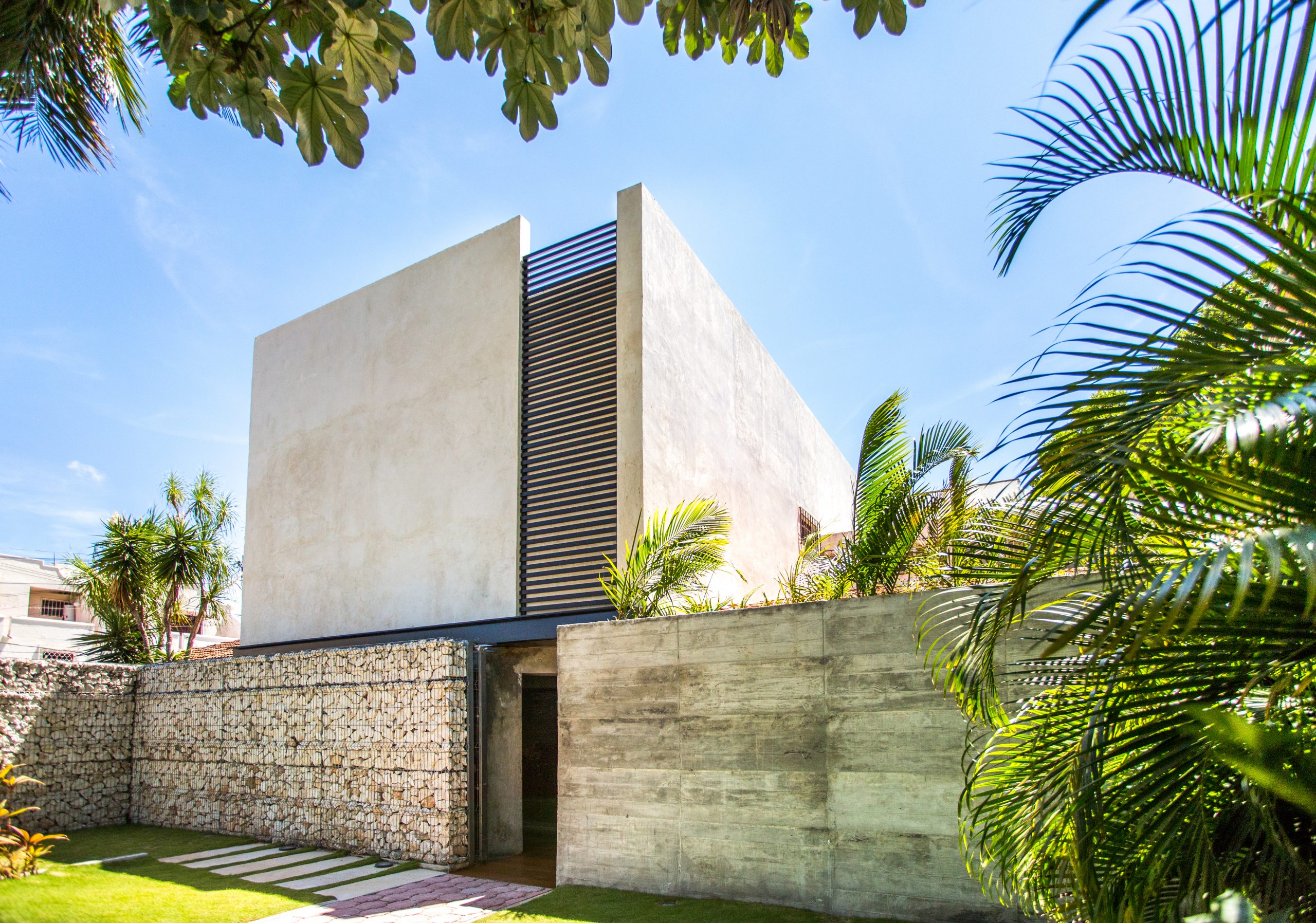 C-Diez
Offices (house conversion) · Cancún · 2012 · BuiltAn abandoned house in Cancún converted into offices; its project page lists gabion walls, a chukum finish and recycled materials.
Photo: Leo Espinosa
Related terms
- Sascab
- Masonry
- Pasta tiles
- Joist and block slab
How is chukum stucco made and applied?
Academic sources on chukum describe how the mortar is prepared, not a standard procedure for applying it to walls. The traditional version mixes lime, sascab and the binder from the chukum tree, which is obtained by macerating the bark in boiling water, according to a 2020 UAM Xochimilco paper and its survey of people in the construction trade. In that same survey, 74% of those who know the technique add white cement to the mix.
Because the recipe differs between the traditional mortar and the semi-industrial products on the market, a chukum finish on a wall is best specified in the construction documents, together with the installer and the data sheet of the chosen product.
How does Arkham Projects use chukum?
According to Arkham Projects, chukum and other continuous mineral finishes are among the materials it uses most, especially in hot climates: they give natural-looking surfaces, blend well with their surroundings and need less maintenance than painted finishes, which must be repainted periodically.
The firm does not work with a fixed palette: it chooses each material according to the context, climate, location, budget and maintenance of each project.
Frequently asked questions
Is chukum used for swimming pools?
Yes, it is one of its most frequent uses. In a survey of people in the construction trade published in 2020 by UAM Xochimilco researchers, 89% of those who know the technique use chukum mortar for swimming pool finishes. The sample was small, 40 responses, so the figure points to a common practice, not an industry statistic.
Sources: [3]
What tree does chukum come from?
Chukum comes from the tree of the same name, Havardia albicans, endemic to the Yucatán Peninsula. According to a paper by the Chetumal Institute of Technology (2019), it has thorny bark and a tannin-rich resin with a wine-like red color. Besides construction, it is used for tanning and in traditional medicine.
Sources: [2]
Is chukum waterproof?
A 2019 study by the Chetumal Institute of Technology tested mortar with 5 to 20% chukum resin: it was stronger than traditional mortar, and the authors recommend it for humid areas because it inhibits mold and is waterproof. That is the result of one study; how a finish performs on site depends on the mix and the application.
Sources: [4]
Is the chukum base sold in stores traditional chukum?
Not quite. Traditional mortar mixes lime, sascab and the binder from the chukum tree. According to a 2022 UAM Xochimilco conference paper, in recent decades chukum has mostly been produced semi-industrially, as a “chukum base” of fine powder and white cement that is distributed throughout Mexico and is starting to be sold abroad.
Sources
- Martínez Barreiro y Guerrero (UAM Xochimilco), «Uso tradicional de morteros con chucum en la península de Yucatán, México», Journal of Traditional Building, Architecture and Urbanism, núm. 1 (2020) — Traditional chukum mortars and renders are made by mixing lime, a local earth called sascab and a plant-based binder from the chukum tree; it is a technique of Maya heritage still used in construction today. (accessed on September 28, 2026)
- Ordóñez Melken, Rodríguez Poot, Gómez Pinzón y Navarrete Canto, «Mortero arquitectónico a base de resina del árbol de Chukum», Instituto Tecnológico de Chetumal (TecNM), ISSN 2594-018X, 2019 — Chukum (Havardia albicans) is a tree endemic to the Yucatán Peninsula, with thorny bark, whose tannin-rich resin gives a wine-like red color; it is used for tanning, in traditional medicine and in construction. (accessed on September 28, 2026)
- Martínez Barreiro y Guerrero (UAM Xochimilco), «Uso tradicional de morteros con chucum en la península de Yucatán, México», Journal of Traditional Building, Architecture and Urbanism, núm. 1 (2020) — In a 2020 survey of construction people, among those who know the technique 95% obtain chukum by macerating the bark in boiling water, 74% add white cement to the mortar and 89% use it for swimming pool finishes. (accessed on September 28, 2026)
- Ordóñez Melken, Rodríguez Poot, Gómez Pinzón y Navarrete Canto, «Mortero arquitectónico a base de resina del árbol de Chukum», Instituto Tecnológico de Chetumal (TecNM), ISSN 2594-018X, 2019 — In a study by the Chetumal Institute of Technology, mortar with 5 to 20% chukum resin was stronger than traditional mortar; the authors recommend it for humid areas because it inhibits mold and is waterproof. (accessed on September 28, 2026)
- Martínez-Barreiro y Guerrero-Baca (UAM Xochimilco), «Traditional mortars with chucum in Yucatan, Mexico, as biocultural heritage», HERITAGE 2022, Editorial Universitat Politècnica de València — In recent decades chukum mortar has mostly been produced semi-industrially, as a “chukum base” of fine powder and white cement that is distributed throughout Mexico and is starting to be sold abroad. (accessed on September 28, 2026)
- Arkham Projects — According to Arkham Projects, chukum and other continuous mineral finishes are among the materials it uses most, especially in hot climates, because they give natural-looking surfaces, blend well with their surroundings and need less maintenance than painted finishes that must be repainted. (accessed on October 5, 2026)
- Arkham Projects — According to Arkham Projects, its choice of materials and building systems starts from each project's conditions: context, climate, location, budget and maintenance; it does not work with a fixed palette. (accessed on October 5, 2026)
Keep reading
- PortfolioHouses designed by Arkham Projects
Houses designed by Arkham Projects in Mérida, Mexico: year, area, status and verified awards of each, and the features that recur across the portfolio.
- ServiceCustom home design in Mérida and beyond
Custom home design by Arkham Projects, founded in Mérida in 2013: who it is for, what is included, the four-step process and typical design timelines.
- GuidesGuides to building in Mérida
Guides to building a house in Mérida, Mexico, with dated sources: building as a foreigner, construction costs, architect fees and chukum.
About Arkham Projects
Arkham Projects is a Mexican architecture and design firm with national and international experience that specializes in real estate development, high-end residential architecture, master plans and hospitality, and seeks to combine differentiation and creativity in design with efficiency and an understanding of the needs of the business and the user.
- more than 100 projects
- more than 70 national and international awards and recognitions
- founded in Mérida in 2013
Talk to us about your project
Message us on WhatsApp or email and we will reply during business hours.
As a reference, Arkham Projects looks for house projects from about 500 m² of built area. The minimum is not a strict rule.
Message us on WhatsApp